

Sophisticated attacks enabled by AI
Senior executives are a prize target for attackers, offering one of the most direct ways to reach deep into an organisation’s systems. Increasingly, sophisticated attacks now start with intelligence gathering: open-source footprints, leaked credentials, travel patterns, and information gathered on the people close to executives. Then AI-enabled techniques let attackers move faster — and at a far greater scale — than was previously possible.
Much of that information is already public. A 2026 study of executive digital exposure1 found that 94% of executives had a home address publicly linked to their name in public records or people-search sites, and 32% of executives or their family members shared geolocation data through fitness apps or geotagged posts. Family members maintained an average of eight public social media accounts each, with 97% of those accounts exposing personal details about the executive. Impersonation accounts using executives' names and photos were found for 15% of them, mostly used for financial scams and social engineering.
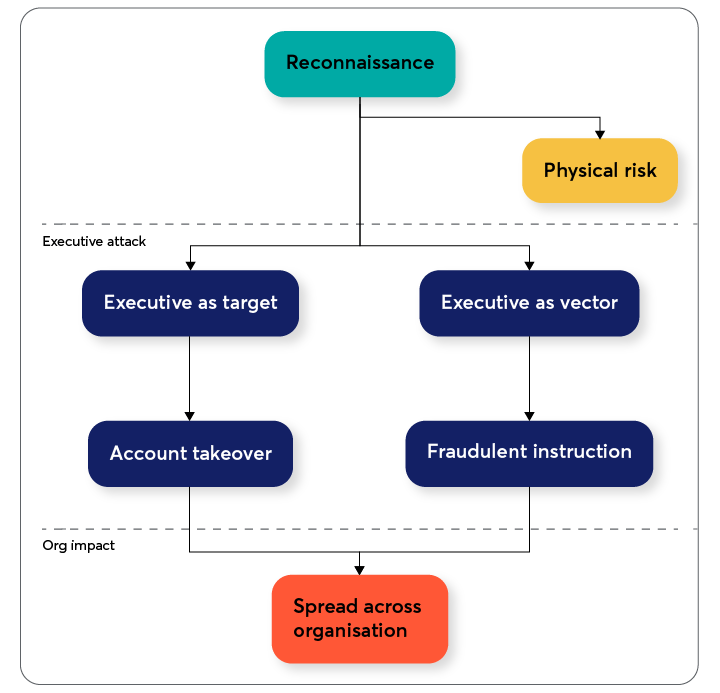
Executives are an attack target and vector into organisations.
Closing the gaps to protect executives
While security professionals recognise the dangers, the risk is rarely owned by a single team with a unified strategy. Executive protection sits across cyber, intelligence, fraud, and physical security at once. That creates gaps that attackers can exploit.
"In the incidents we handle, the executive is often the starting point for a wider attack. When strong technical controls are in place, attackers may go after people instead — they treat senior executives as a way into the whole organisation, find an opening, and scale from there.”— Jan Kaastrup, Chief Cybersecurity Advisor, CSIS
The appeal to attackers is efficiency. Compromising a junior employee buys a foothold that still needs weeks of lateral movement to reach anything valuable; compromising an executive can deliver signing authority, sensitive data, or financial access in a single step. That is why leadership is increasingly the target — and why the same public exposure gets used two ways: to deceive the executive directly, or to impersonate them so that instructions to finance, HR, or IT carry the weight of a real name.
Watch the executive protection webinar
CSIS Security Group and our threat intelligence division SecAlliance ran a 60-minute panel on executive protection in September 2026. The session covered the specific types of attacks now being orchestrated against senior leaders, what AI is genuinely changing, and what security leaders should do in response.
The recording is now available on demand.
Drawing on real cases and threat intelligence investigations, the panel covered:
- How executive targeting is changing, and why attackers increasingly treat leadership as the way in
- What real cases reveal about how these attacks unfold
- What AI is genuinely changing about impersonation, deepfakes, and the speed of targeting
- Where cyber exposure turns into physical risk
- Who else belongs in scope — assistants, family members, and household staff
- What security leaders should prioritise first to reduce executive vulnerability
Intelligence and cybersecurity experts
The session was run by practising professionals from CSIS and SecAlliance:
- Natasia Kalajdziovski — Senior Threat Intelligence Analyst, SecAlliance
- Aadrien Luke — Head of Fusion, SecAlliance
- Jan Kaastrup — Chief Cybersecurity Advisor, CSIS
Watch on demand
🎥 Format: On-demand recording
⏱ Duration: 54 minutes
📅 Originally broadcast: September 2026
Executive protection essentials
What is digital executive protection?
Executive cyber protection is the practice of reducing the digital risks that specifically target senior leaders, extending traditional executive protection beyond physical security. It addresses threats such as phishing and impersonation, credential and identity compromise, doxxing, and deepfakes, and it treats an executive's personal devices, home network, and online footprint as part of the organisation's attack surface. Because that exposure can lead to fraud, data loss, or physical targeting, executive protection should be managed as a coordinated effort across cyber, intelligence, fraud, and physical security.
Why are senior executives targeted?
Executives hold access, authority, and visibility, which makes them a shortcut to systems, funds, and decisions. Attackers build a picture from open-source information, leaked credentials, and travel or network details, then use impersonation, fraud, and AI-enabled techniques to act on it.
Who else should be included besides the executive?
Executive assistants, heads of IT, drivers and household staff all hold or handle information about the executive, often with less scrutiny than the executive receives. Family members matter too: research in 2026 found family members held an average of eight public social media accounts each, with 97% of those exposing personal details about the executive.¹
Who should own executive protection?
It rarely fits neatly into one team. Executive risk spans cyber, threat intelligence, fraud, and physical security, so protection works best when those functions coordinate rather than leaving it to IT alone.
How can organisations reduce executive exposure?
Intelligence-led monitoring can surface exposure earlier — leaked credentials, impersonation attempts, and physical-risk indicators — so it can be dealt with before an attack lands. The webinar covers where security leaders should focus first.
How is digital executive protection different from physical executive protection?
Physical executive protection manages risk to the person: drivers, residential security, secure travel. Digital executive protection manages the information that makes a person findable and approachable in the first place. The two are connected, because a leaked home address or a shared running route can turn an online exposure into a physical risk, so they work best when planned together.
Go deeper: preparing senior executives
Protecting executives is one side of the problem. The other is what happens if an incident does reach leadership and decisions must be made quickly and under pressure.

Our mini-guide, How to strengthen your crisis readiness in three months (or less), sets out 15 practical ways to prepare your leadership team to act, with a checklist you can work through directly.
For more on why this belongs on the executive agenda rather than just with IT, see Cyber Crisis Management: The Critical Role of Executive Leadership in a Cyberattack.
References
1. Nisos 2026 Executive Digital Exposure Trends, July 2026.
Stay updated
Sign up for our newsletter and get the latest cybersecurity analysis, reports and events from CSIS delivered straight to your inbox.

CSIS Newsletter